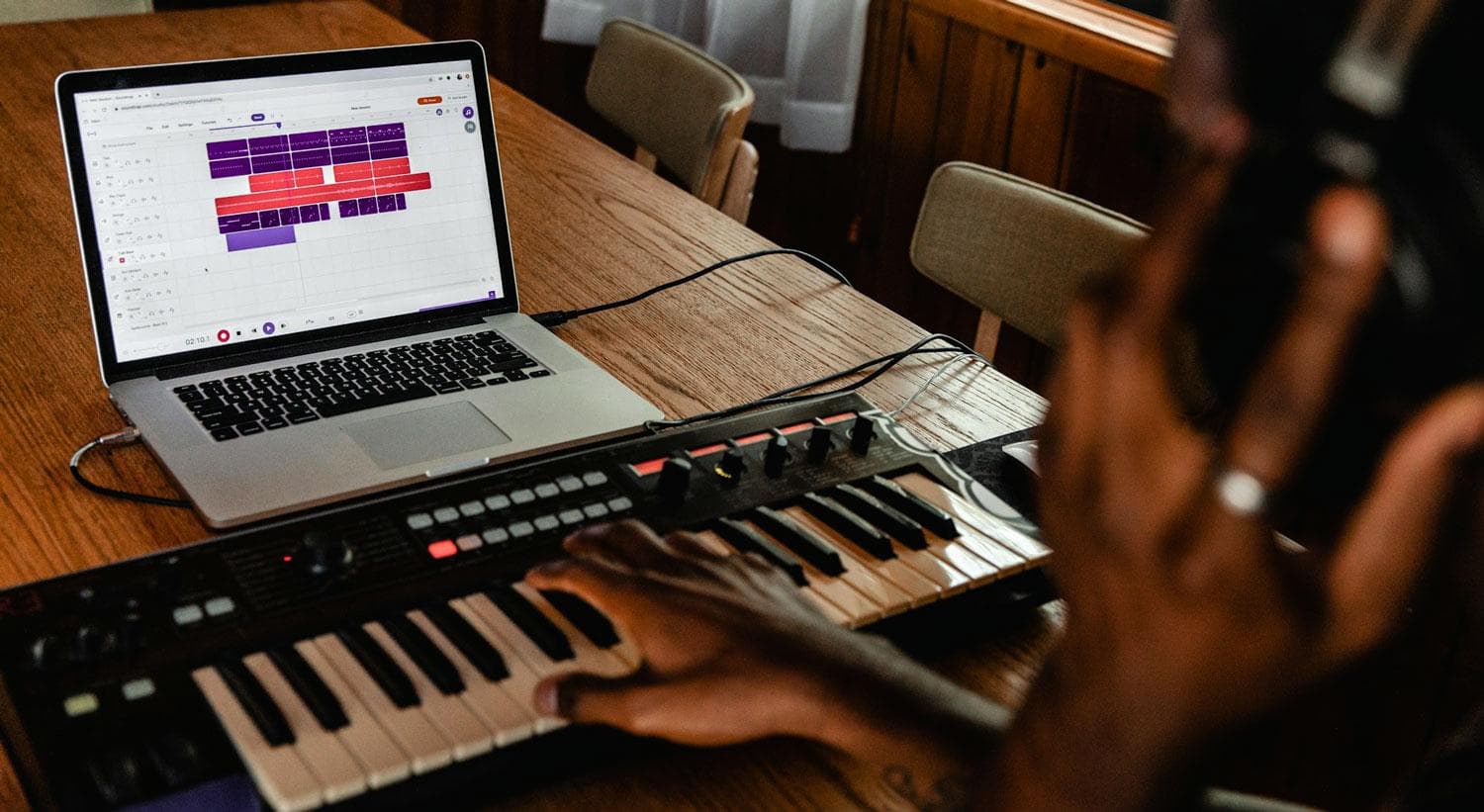
In animation, sound is almost always added too late. First, the image is drawn, the movement is constructed, the frames are polished—and only at the end does the thought arise: “Now let’s add sound.” This is where most problems arise. Animation is not a visual art with added sound, but an audiovisual system in which movement and sound share the same temporal logic.
If the sound is done formally or secondhand, the viewer senses it immediately, even if they can’t explain why the video “doesn’t work.” For an animator, sound is a tool for timing, rhythm, and the perception of weight, inertia, and emotion. And the earlier it appears in the process, the more powerful the result.
Sound Timing
Animation timing almost never exists in isolation. Even in silent animation, it is grounded in an internal rhythm that is readily translated into sound. In real-life projects, sound helps us understand where a movement is drawn out, where it’s abrupt, and where it’s unconvincing.
A simple example: an object falling. Without sound, an animator can make the movement look “beautiful,” but its weight is unconvincing. Adding a sound accent at the moment of impact immediately reveals the error: if the sound is “before” or “after” the visual impact, the brain detects a false note. This rule also works in reverse—a well-placed sound impact can “pull” imperfect animation.
A professional practice is to work with rough sound already at the animatic stage. Even simple clicks, noises, or a metronome allow us to:
- more accurately sense the duration of pauses,
- build accents within the movement,
- avoid “floating” rhythms in scenes.
Animators who ignore sound early on often compensate for timing issues with additional frames or excessive motion, thereby complicating scenes that require rhythm. However, streaming services and gambling industries have recently become more adept at addressing this issue—modern online bookmaker non AAMS operating in the European market now produce clear and distinct sound for their commercials, including those generated by artificial intelligence, as well as effects accompanying the gaming process.
Foley
Foley is an imitation of real sound. In animation, the “real” sound of an object is rarely used. Instead, a sound appropriate for the given movement and scale is employed. It’s important for animators to understand that Foley is directly related to:
- sense of mass,
- material of the object,
- distance to the camera,
- speed of movement.
If a character takes a step and the sound of the step doesn’t coincide with the phase of weight transfer, the movement loses its physicality. If an object falls without a corresponding aural response, it feels hollow or plastic—even if it visually appears heavy.
A useful practice for animators is to have at least a basic understanding of Foley notations:
- how steps are created for different surfaces,
- why the same sound can’t be used for different scales,
- how layering (superimposing multiple sounds) enhances the feel of an object.
Even if a project has a dedicated sound designer, it’s helpful for animators to understand the expected sounds so as not to introduce contradictory cues into the movement.
Music
Music in animation is a temporal grid that dictates the pacing of scenes, shot transitions, and emotional dynamics. A common mistake in many projects is selecting music “to match the finished image.” As a result, the music is either cut short or works against the flow. It’s especially important for animators to consider:
- tempo (BPM),
- track structure (intro, development, accents),
- presence of pauses and breaks.
If an animator knows that a scene will be synchronized to a specific music track, this should influence the storyboard and animatic. Even if the final track changes, the understanding of the scene’s musical logic remains.
An interesting professional technique is to animate to a temporary musical “skeleton” (a simple beat or loop) rather than to the final track. This preserves the scene’s rhythm and simplifies subsequent adaptation.
Common Mistakes Animators Make When Working with Sound
Even experienced animators regularly make the same mistakes:
- Ignoring silence as a rhythmic element;
- Trying to “save” a scene with sound instead of correcting the timing;
- Using the same sounds for different actions;
- Not synchronizing key poses with audio accents.
Sound doesn’t fix bad animation. It only highlights its strengths and weaknesses. Therefore, the sooner sound becomes part of an animator’s thinking, the more consistent the results will be.
Why do viewers not forgive poor sound
The human brain processes sound faster than images. If the sound says one thing and the image says another, cognitive dissonance arises. The viewer might not notice an interpolation error, but immediately senses a falseness in the audio. This is why projects with excellent graphics and poor sound are perceived as cheap, whereas visually simple works with precise sound design are perceived as professional and cohesive. For an animator, this means one simple thing: sound is not someone else’s responsibility. It’s part of the profession, even if you don’t work directly with a microphone and editing.